Consistent by design: making AI-generated product content you can trust
How SIMPI keeps AI-generated product content consistent across steps, variants and languages with a product model, independent checks and source traces.
“Can’t we just use Claude for this?”
The question comes up in almost every conversation about AI-generated product content, and it is a fair one. General AI assistants such as Claude, ChatGPT or Gemini write fluent text and produce striking images in seconds. Ask one for a step-by-step guide to descaling a coffee machine and you will get a convincing answer.
The problem is not one answer. It is the hundredth. Product information is a system of many pieces that must agree with each other: the same part must look the same in step 3 and step 17, carry the same name in the German and the English version, and match the real product on the customer’s kitchen counter.
A chat window gives you a talented writer with no memory, no product in front of it and no one checking its work. This article explains where that breaks, how SIMPI builds consistency into the process instead, and what becomes possible once you have it.
Where consistency is not optional
In a marketing slogan, variety is a feature. In product information, every inconsistency is a support call, a return or a safety risk. Consistency matters on five levels:
| Level | What must stay the same | What goes wrong otherwise |
|---|---|---|
| Within a picture | Number of buttons, position of the drawer, cable side | The customer looks for a button that does not exist |
| Across steps | The same part looks identical from step 1 to the last step | “Is this the same lid or a different one?” |
| Across products and variants | Shared parts look shared, different parts look different | Instructions for model A shown for model B |
| Across languages and channels | Names, warnings and values match in every language, on paper, web and app | A warning present in German, missing in French |
| Across time | A small product change updates every affected step, nothing else | Old and new versions mixed in one manual |
On top of this come obligations. Safety warnings must appear where the manufacturer’s source says they appear, values such as temperatures and torques must be exactly right, and with rules like the EU Machinery Regulation and the Digital Product Passport on the way, manufacturers need to show where each statement came from.
Where AI models struggle
Today’s models are remarkable, but they share a few blind spots that matter a lot for product content.
-
They cannot see what they were not shown. Ask for “the filter behind the side panel” and the model has to imagine it. It will draw a plausible filter, not yours. Without a reference, every hidden part is a guess.
-
They fill gaps with confidence. A missing detail is not left blank; it is invented, and it looks just as convincing as the real details. Image models add a second knob, a different handle or an extra vent because “devices like this usually have one”.
-
They drift. Generate the same device twice and you get two slightly different devices: a little more zoomed in, a slightly different colour, a button moved. Each image is fine on its own. Side by side, they are two products.
-
They count and place poorly. Five screws, left versus right, the third slot from the top: precise spatial facts are exactly where image generation is weakest.
-
Text inside images breaks. Labels, display content and symbols come out garbled or subtly wrong.
-
They forget between sessions. A chat has no lasting memory of what step 4 looked like when you work on step 12 next week.
-
They change underneath you. A model update can change style and behaviour overnight. The same request no longer gives the same result.
None of this makes the models useless. It means their output has to be treated as a draft that must be checked against the truth, every time.
Why a chatbot, even with your manual attached, falls short
The natural next step is to give the assistant context: upload the manual, a few photos, the parts list. That helps, and it is still not enough. The difference is between asking one expert once and running a production line with quality control.
| Asking an assistant with context | A generation and check process | |
|---|---|---|
| Who checks the result | The same model that wrote it, or nobody | Separate checks, each looking for one kind of error |
| Source of truth | A long document the model skims; details at page 80 fade | A structured product model: parts, positions, states, values |
| Same request tomorrow | A different answer | The same answer, because inputs are pinned and versioned |
| Hidden parts | Imagined | Taken from a reference, or flagged as unknown |
| Errors | Look exactly like correct content | Reported with evidence, so a person can decide fast |
| Where did this come from? | No answer | Every step traces back to its source page, photo or decision |
| A change to one part | Regenerate and hope the rest stays | Only the affected steps are redone, the rest stays byte for byte |
There is a simple reason why self-checking does not work: a model that misread page 80 will misread it again when asked to check itself. Real quality comes from checks that look at the output from a different angle, with their own evidence, against a source that does not move.
The SIMPI approach: generate, check, trace, version
SIMPI does not ask a model for a manual. It builds the manual from small, checked pieces, and the model is one worker on that line, not the whole factory.
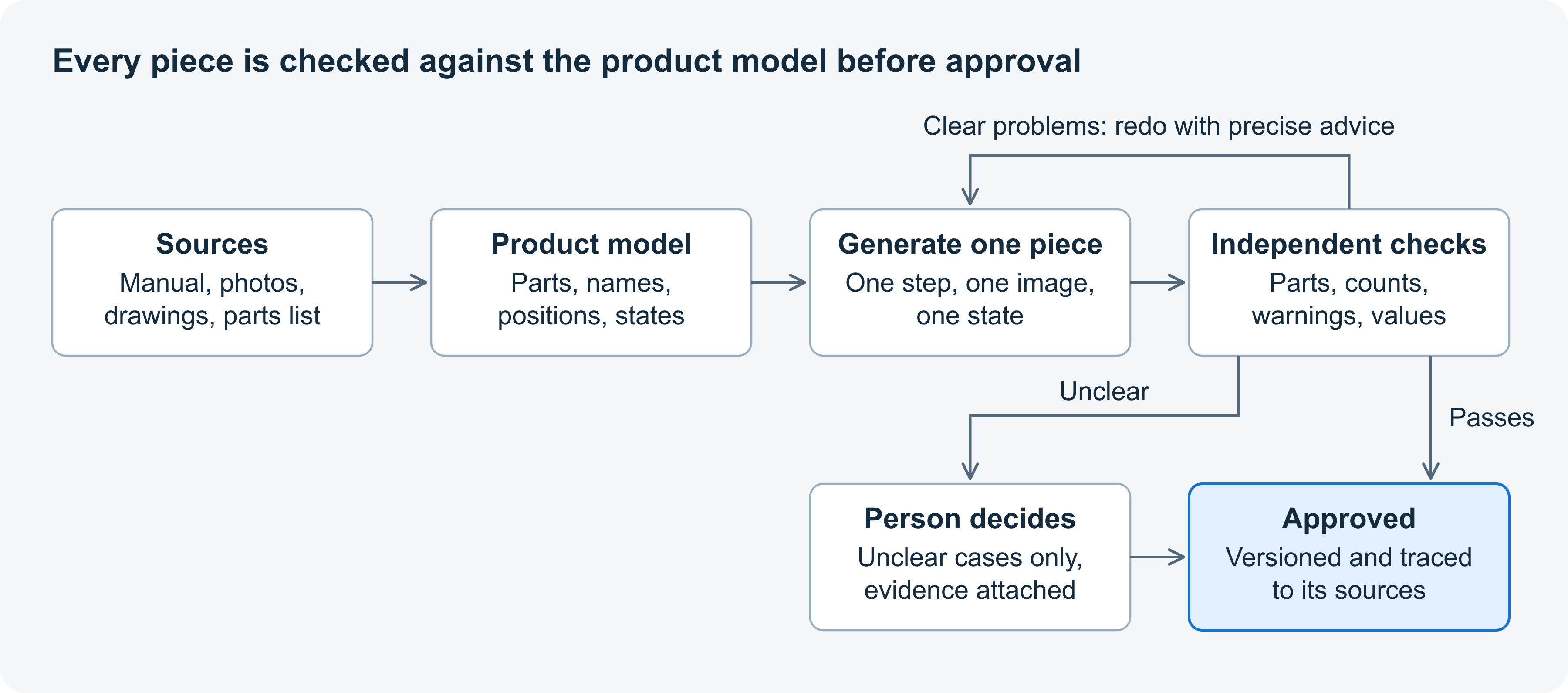
Generate and check loop: six stages, three outcomes.
Clear problems loop straight back into generation; only unclear cases reach a person, and nothing is approved without its trace to the sources.
-
Start from the truth. The process begins with what the manufacturer already knows: the existing manual, real photos, drawings, parts lists. From this, SIMPI builds a structured model of the product: which parts exist, what they are called, where they sit, and which states the device can be in.
-
One master image, many renditions. Every visual starts as a clean line drawing that follows the real product. Renderings, pro-style photos and video frames are derived from that master, never invented separately. This keeps part positions identical across every style.
-
Generate small and specific. Instead of “write the descaling chapter”, the system asks for one step, one image, one state, with exactly the facts that step needs.
-
Check every piece independently. Separate checks compare each result against the product model and the sources: Are the right parts visible? Is the count right? Is the warning there? Does the value match the source page? Each finding comes with its evidence.
-
Repair or escalate. Clear problems go back into generation with precise advice. Unclear ones go to a person, who sees the issue and the evidence side by side instead of proofreading everything.
-
Trace and version everything. Each sentence and each image knows where it came from and which version of the product it belongs to. When a part changes, it is clear exactly which steps are affected.
In addition, SIMPI keeps a list of known weak spots per product, for example a part that models tend to draw wrong, and feeds it into generation up front. Quality is measured on fixed test products, so a new model only replaces an old one when it is proven better.
Why SIMPI deliberately does not depend on 3D models
Some approaches build product visuals from CAD or 3D models. That gives precise geometry, and the appeal is understandable. SIMPI made a conscious choice not to depend on them, because in practice the model is rarely the hard part. Getting it, preparing it and keeping it current is.
- They are often not available. Many products are built by suppliers or sold under a different brand. Older products in the field were never modelled at all, and these are often the ones that need repair guides most.
- They are not ready to use. Engineering models are heavy and confidential, and they are full of internal detail. They need to be simplified, cleared for release and given realistic materials before they show what a customer sees.
- They have to be kept in sync. Every product change means a new export, a new preparation round and a new release process, usually involving another department.
- They need specialist skills. Someone has to own the 3D pipeline, either at the manufacturer or at the service provider.
Instead, SIMPI starts from what every product already has: its manual, its photos, its parts list. Today’s models can turn these into accurate, consistent visuals, provided every result is checked against the product model as described above. This makes it possible to start in days, cover products nobody ever modelled, and keep content current without waiting for engineering.
What consistency makes possible
Once the product is described once and every output is derived from that description, content stops being a one-off project and becomes something you can multiply.
-
Many configurations, one source. Variants with a different lid, an extra accessory or a regional plug share every step they have in common and differ only where the product differs.
-
Many styles, same geometry. Line drawings for the printed manual, renderings for the web, pro-style photos for marketing and landscape frames for video, all showing the part in exactly the same place.
-
Many purposes. First steps out of the box, everyday operation, care and repair, troubleshooting: different documents built from the same parts, names and warnings.
-
Many languages. Text is generated per language from the same structured steps, so a warning cannot get lost in translation.
-
Updates in hours, not months. A changed part triggers a targeted update of the affected steps and images. Everything else stays exactly as approved.
-
Proof on request. For every statement, you can show its source, its version and who approved it.
What it would take without AI
All of this can be done by hand, and for decades it was. It is just slow and expensive, which is why most products ship with one manual in one style and few updates.
| Output | Traditional way |
|---|---|
| Line drawings per step | Technical illustrator, often from CAD |
| Renderings | 3D artist, CAD clean-up, scene setup, render |
| Pro photos | Studio shoot per variant and per step, retouching |
| Each additional variant | Redraw or reshoot the differing steps, recheck the rest |
| Each language | Translation, layout check, review |
| A product change | Find every affected page and picture by hand, redo, recheck |
The hidden cost is consistency itself: different illustrators, shoots months apart and separate agencies per language each introduce their own drift. This process does not remove people; it moves them from producing every piece to approving the pieces that matter.
Four more things that make the difference
People stay in charge, but only where they add value.
Nobody should proofread 400 images looking for a missing screw. The checks point the reviewer to the five that need a decision, with the evidence attached. The reviewer’s decisions are kept, so the same question is never asked twice.
No dependence on a single model.
Models improve every few months, and each one has different strengths. SIMPI regularly tests new models against the same fixed set of products and only switches when the results are measurably better. In a recent comparison, one widely praised image model invented parts and changed colours more often than the model already in use, so SIMPI stayed with it. Your content does not change just because a vendor released something new.
Quality is measured, not felt.
SIMPI keeps reference products with a known correct answer for every step. Each change to the process is scored against them. This shows whether an improvement is real and catches a step backwards before a customer does.
Your knowledge stays yours.
Your product data, photos and generated content are processed through Microsoft Azure. They are not used to train AI models and are not shared with model providers such as OpenAI. Real product photos are only used where you decide.
Six questions to ask any AI content approach
Whether you build in-house, use a general assistant or work with a provider, these questions separate a demo from a process:
- If I run the same request twice, do I get the same part in the same place?
- What happens when the model does not know what a hidden part looks like?
- Who or what checks the output, and is it independent of the thing that made it?
- Can you show me the source of any sentence or image in the result?
- When my product changes, what exactly gets redone, and what stays untouched?
- What do you need from us to get started, and does it work for older products too?
So, can you use Claude for this?
Yes, for a first draft, an idea or a single image. SIMPI uses the same kind of models every day. What a chat window cannot give you is the system around the model: a product model as the single source of truth, independent checks, traces back to the source and versions that keep a hundred pieces in agreement.
That system is what turns impressive AI output into product information your customers can rely on, in every variant, style and language.
Want to see it on your product? Get in touch with SIMPI to see what consistent, traceable product content looks like for one of your own devices.